
A Messaging House: What It Is and Why Brands Need It

A messaging house is the framework that organises your core messages into a structure your entire organization can use. It becomes the foundation for your website copy, sales conversations, marketing campaigns, investor presentations, and media strategy.
A strong brand strategy relies on consistency. So should your messaging. That's where the messaging house framework comes in—ensuring your brand voice is communicated clearly, consistently, and confidently across every touchpoint.
The concept gained traction in the '90s, an era that gave us some of the most memorable brand messaging in history: *Just do it* (Nike). *Think different* (Apple). *Intel inside* (Intel). They were the result of disciplined messaging frameworks.
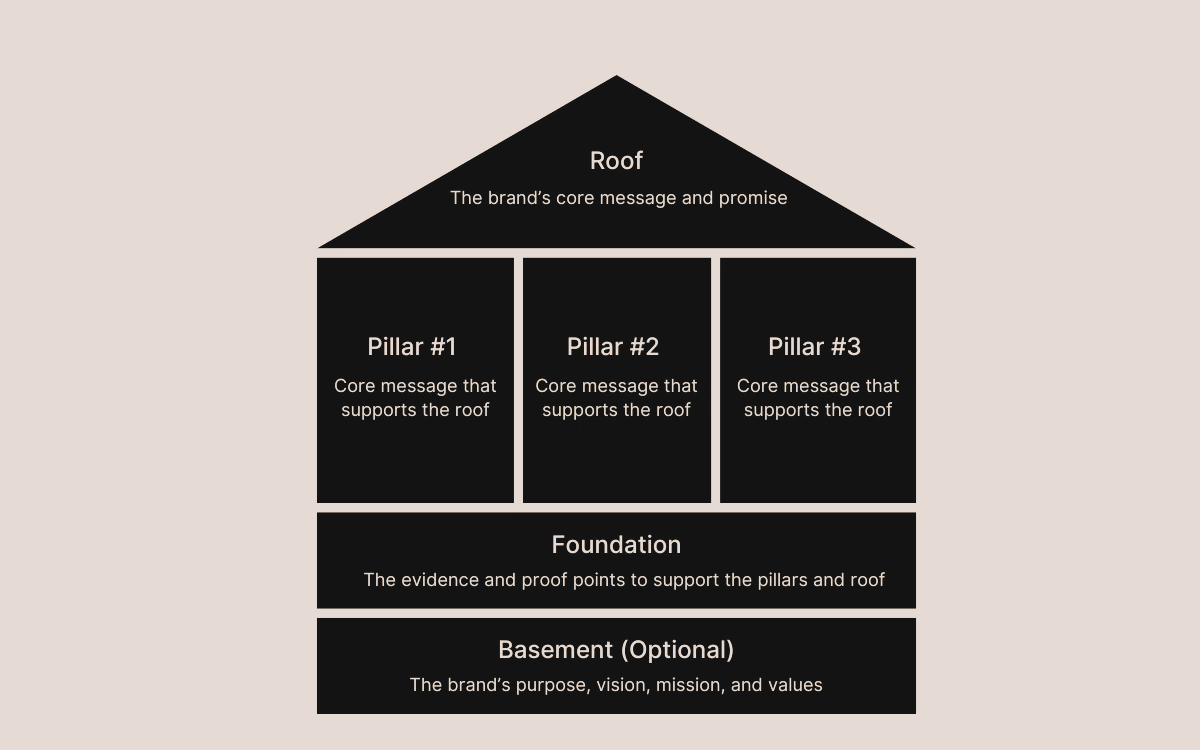
Sample message house
What Is a Messaging House?
Yes, it's literally a house that holds your messaging.
A messaging house is a framework that organizes your brand's core messages into a clear, hierarchical structure. And yes, it really does resemble a house.
Here's what comprises a messaging house:
The Roof: Your core message and brand promise—the single most important thing you want every audience to know.
The Pillars: The 3-5 key messages that support and prove your core message. Each pillar addresses a different dimension of your value.
The Foundation: The evidence and proof points—stats, case studies, awards, customer stories—that back up your pillars and roof.
The Basement (optional): Some messaging houses include your brand's purpose, vision, mission, and values at the base as a reminder of *why* the messaging matters.
As simple as this sounds, it's a profoundly helpful way to organize your messaging and ensure your team isn't reinventing the wheel every time they need to communicate.
Why Brands Need a Messaging House
Competing in crowded markets, a messaging house provides far more than just organized language. Here's what it does:
1. Consistency Across Teams
A messaging house aligns everyone across your organization—from sales and marketing to customer success and leadership. External-facing teams represent the brand in unison. Internal teams become confident brand ambassadors because they have the exact language to use.
2. Clarity in a Noisy Market
Customers are overwhelmed with options. A messaging house helps you simplify complex ideas into clear, memorable concepts. When your team can articulate what makes you different in 30 seconds, your audience can too.
3. Differentiation That Sticks
Your competitors are probably saying similar things. A messaging house forces you to articulate what makes you truly different—not just what you do, but *why* you do it and *how* you do it better.
4. Speed and Efficiency
When your messaging is documented and agreed upon, your team moves faster. No more debating what to say. No more starting from scratch for every pitch deck, website page, or LinkedIn post.
5. A Holistic Brand
The words and messaging you use should reinforce your brand strategy and identity. A good messaging house powers this connection, ensuring everything ladders back to who you are and what you stand for.
6. Media and Content Readiness
This framework guides internal media training, prepares executives for interviews, and serves as the roadmap for your content strategy. It ensures a common thread ties together all your communications.
The Bottom Line
A messaging house isn't just a marketing deliverable. It's the infrastructure that turns brand strategy into language your team can actually use.
Because your brand isn't what you write in a strategy deck. It's what your team says in sales calls, LinkedIn posts, customer meetings, and conference presentations.
And if those moments aren't aligned, your brand isn't either.
At KITE, we build messaging houses that are rooted in strategy, shaped by your team's input, and designed to actually get used—not filed away.
If your messaging feels scattered—or if your team is spending too much time debating what to say instead of executing—let's talk.
